
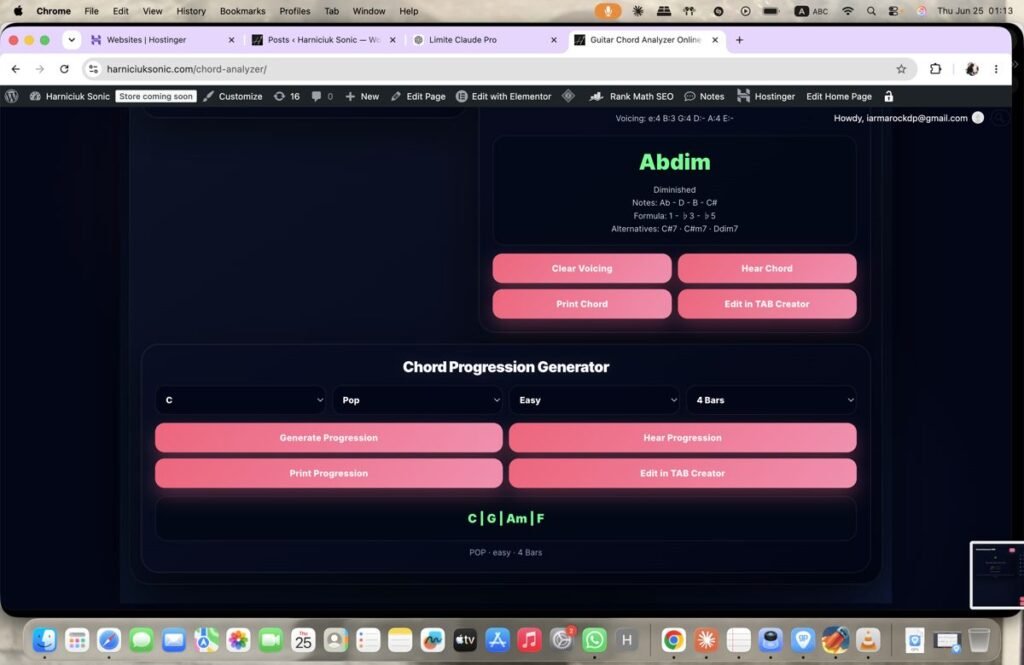
Guitar chord progressions start making sense once you can name what each chord is doing, not just what it’s called. This guide covers the progressions you’ll actually run into, a practical method for transposing them, and how to test them with Harniciuk Sonic’s tools.
Why guitar chord progressions matters
Chord names change with the key, but the underlying pattern doesn’t — a I-IV-V progression is the same relationship whether it’s C-F-G or D-G-A. Learn the pattern once and you can play it in any key without relearning it from scratch. Work slowly enough to notice timing, unwanted noise and tension. Then increase the difficulty only when the movement stays relaxed.
Keep one measurable goal for each session. A clear goal might be four clean repetitions, one complete chorus without stopping, or a recording that stays in time. Small evidence is more useful than practising for a long time without listening.
Five Progressions Worth Knowing (in the Key of C)
These five guitar chord progressions cover most of what you’ll hear in rock, pop, blues and folk. They’re written here in C major so you can see real chord names, but the Roman numerals are what actually transpose to other keys.
I-IV-V (C-F-G): The most common progression in popular music. Almost every 12-bar blues, folk song and simple rock tune leans on some version of this.
ii-V-I (Dm-G-C): The backbone of jazz standards. The move from Dm to G pulls strongly back to C, which is why it shows up at the end of so many phrases.
vi-IV-I-V (Am-F-C-G): Often called the “pop progression” — it’s the chord sequence behind a huge number of contemporary pop and rock songs, in every key.
I-V-vi-IV (C-G-Am-F): The same four chords as above, reordered. Starting on the I instead of the vi gives it a brighter, more resolved opening.
12-bar blues (C-C-C-C, F-F-C-C, G-F-C-G): Three chords, four bars each, in a set order. Swap the plain triads for dominant 7th chords (C7-F7-G7) for a more traditional blues sound.
A step-by-step method
Write the chords, identify the key, convert each chord to a Roman numeral and transpose the pattern to a second key.
- Set one musical goal and remove unnecessary options.
- Play slowly enough to stay accurate and relaxed.
- Record or listen back before increasing speed.
- Repeat the successful version, then change only one variable.
This sequence keeps the ear involved. It also prevents the common habit of changing tempo, tone, fingering and harmony at the same time. When only one variable changes, you can understand why the next attempt improved.
A focused practice drill
Play I-V-vi-IV in two keys, then change the rhythm while keeping the harmonic order unchanged.
Use three rounds: an orientation round, a clean repetition round and a musical round. During the last round, add dynamics, articulation and phrasing. The goal is to turn a technical action into something you could use in a riff, lesson, rehearsal or recording.
Common mistakes to avoid
When analysing guitar chord progressions, avoid guessing the key from the first chord alone, and don’t ignore inversions that create smoother bass movement.
Another mistake is continuing after concentration drops. Stop, identify the exact problem and restart with a smaller task. Ten attentive minutes usually create a better result than an unfocused hour.
Use the result with Chord Analyzer
Analyse each chord, compare shared notes and test a progression before taking it to the fretboard. Open the tool, complete one useful action and then continue to a lesson, backing track or upload. This keeps practice connected to real music.
Build a connected guitar workflow
Harniciuk Sonic connects practice, learning, creation and publishing. Start with the guitar tools, use a focused exercise, and continue with the Lessons Hub when you need a structured next step. Creators can turn the finished idea into a TAB, lesson or marketplace resource.
Frequently asked questions
How long should I practise this?
Start with ten focused minutes on one guitar chord progression. Continue only while you can hear and correct the result. Consistency across several days matters more than one exhausting session.
When should I increase the difficulty?
Increase tempo, range or complexity after several relaxed and accurate repetitions. If timing or tone collapses, return to the last version you could control.
Do I need special equipment?
No. A guitar, careful listening and the relevant Harniciuk Sonic tool are enough to begin. Headphones or a simple recording can make evaluation easier.
Related reading
Once progressions feel steady, connect the shapes to the fretboard with Minor Pentatonic Scale Positions for Guitar, or see how a chord-recognition app can speed things up in Discover the Best Guitar Chords App for Your Musical Journey. If you would rather start by identifying the chord in front of you, see How to Identify Guitar Chords and Create Chord Progressions.
Practice smarter with Harniciuk Sonic’s free guitar tools — open Chord Analyzer and level up today.