

Guitar Guides · Harmony & Chords
Play a chord, get its name, formula, and alternatives instantly. Then build progressions that actually work — in any key and any style.
🕑 9 min read
🎸 All levels
📅 Updated June 2026
You’ve found a chord shape that sounds interesting — but you don’t know what it’s called. Or you’re writing a song and you don’t know what chord comes next. A guitar chord analyzer solves both problems: it identifies what you’re playing and helps you build what comes after.
Quick Answer
A guitar chord analyzer identifies the name, formula, and note content of any chord — either by detecting it through your microphone or by entering a fretboard voicing manually. The Harniciuk Sonic Chord Analyzer also includes a Chord Progression Generator that builds complete progressions in any key and style.
What a chord analyzer actually tells you
When you play a chord and run it through an analyzer, you get back more than just a name. Understanding each piece of information makes you a more intentional player and songwriter.
The chord name
The most basic output — Am, G7, Cmaj7, Abdim. The name tells you the root note and the quality (major, minor, dominant, diminished, augmented, and so on). Once you know the name, you can find the chord in any song chart, lead sheet, or tab.
The formula
The interval formula tells you why the chord sounds the way it does. A minor chord is 1 – ♭3 – 5. A dominant 7th is 1 – 3 – 5 – ♭7. A diminished chord is 1 – ♭3 – ♭5. Learning formulas turns chord knowledge from memorized shapes into transferable theory — you can build any chord from scratch in any key once you understand the intervals.
The notes
The individual note names (e.g. Ab – D – B – C# for an Abdim) let you see exactly what pitches you’re playing. This is essential for understanding voice leading — how notes move from one chord to the next — and for identifying which scale degrees are present.
Alternative chord names
Many chords have multiple names depending on context. Abdim is also C#dim7, C#m7, and Ddim7 in certain inversions. Knowing the alternatives helps you read different notation styles and understand why the same physical shape gets different names in different situations.
The most important chord types every guitarist should know
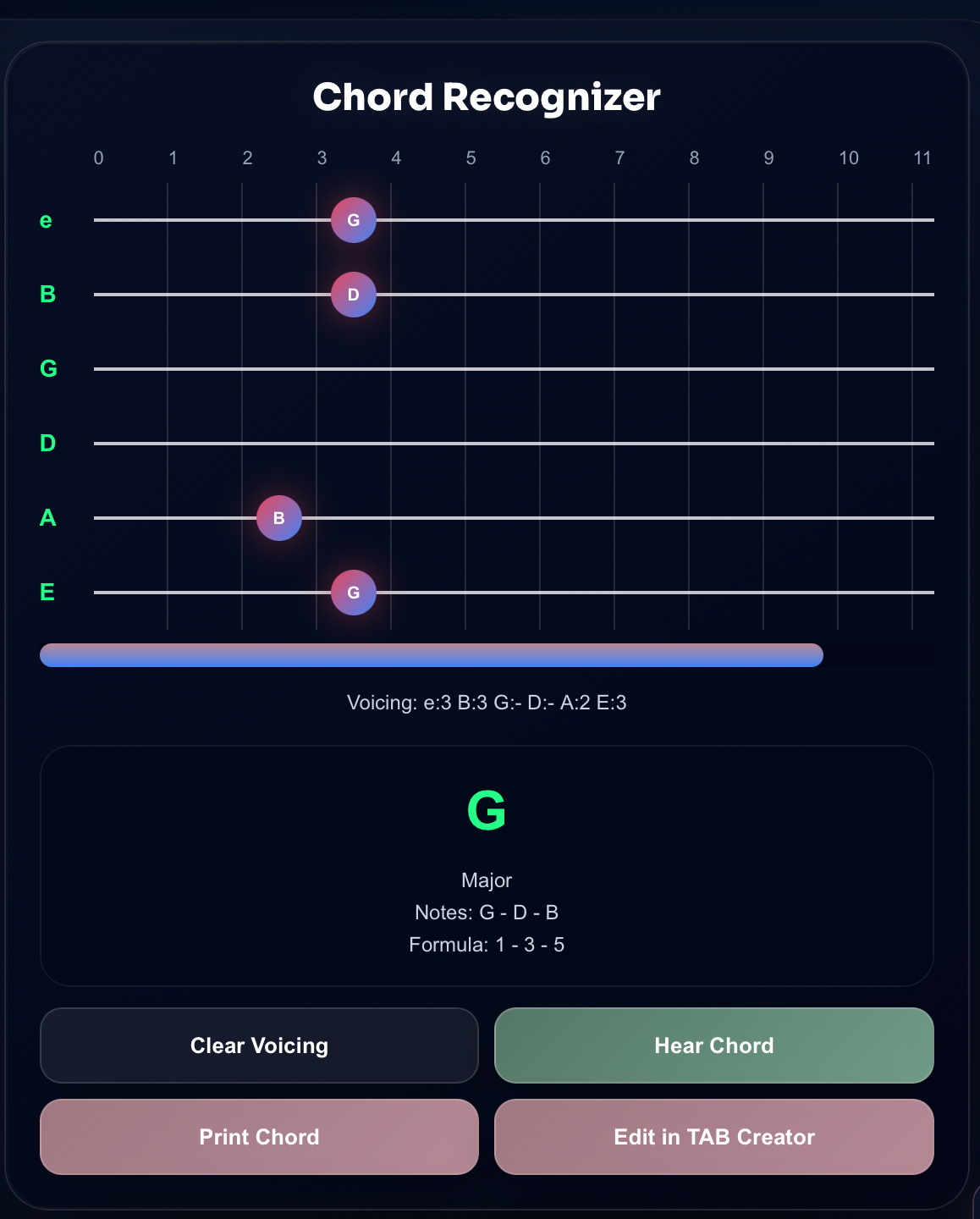
maj
Major
1 – 3 – 5
Bright, resolved
min
Minor
1 – ♭3 – 5
Dark, emotional
7
Dominant 7th
1 – 3 – 5 – ♭7
Blues, tension
maj7
Major 7th
1 – 3 – 5 – 7
Jazz, dreamy
m7
Minor 7th
1 – ♭3 – 5 – ♭7
Soul, funk, jazz
dim
Diminished
1 – ♭3 – ♭5
Tense, dramatic
sus2
Suspended 2nd
1 – 2 – 5
Open, floating
sus4
Suspended 4th
1 – 4 – 5
Unresolved, tense
add9
Add 9th
1 – 3 – 5 – 9
Rich, modern
How to use the Harniciuk Sonic Chord Analyzer
The Chord Analyzer has two detection modes — microphone-based real-time detection and manual voicing entry. Here’s how each one works:
Mode 1: Chord Detector PRO (microphone)
01
Allow microphone access and click Start
The Chord Detector PRO uses your device microphone to listen in real time. Click Start and allow mic access when prompted. The analyzer begins listening immediately — no further setup needed.
02
Play a clean, full chord strum
Strum a chord cleanly — all strings ringing clearly, no mutes or buzzes. The Chord Recognizer maps each detected note to its position on the fretboard in real time, showing exactly which fret and string each note came from.
03
Read the chord identification
Below the fretboard map, the analyzer shows the chord name in large text, its quality (major, minor, diminished, etc.), the exact notes detected, the interval formula, and any alternative names for that voicing. This is all calculated from what your guitar actually played — not from a preset list.
Chord Detector PRO — harniciuksonic.com/chord-analyzer/
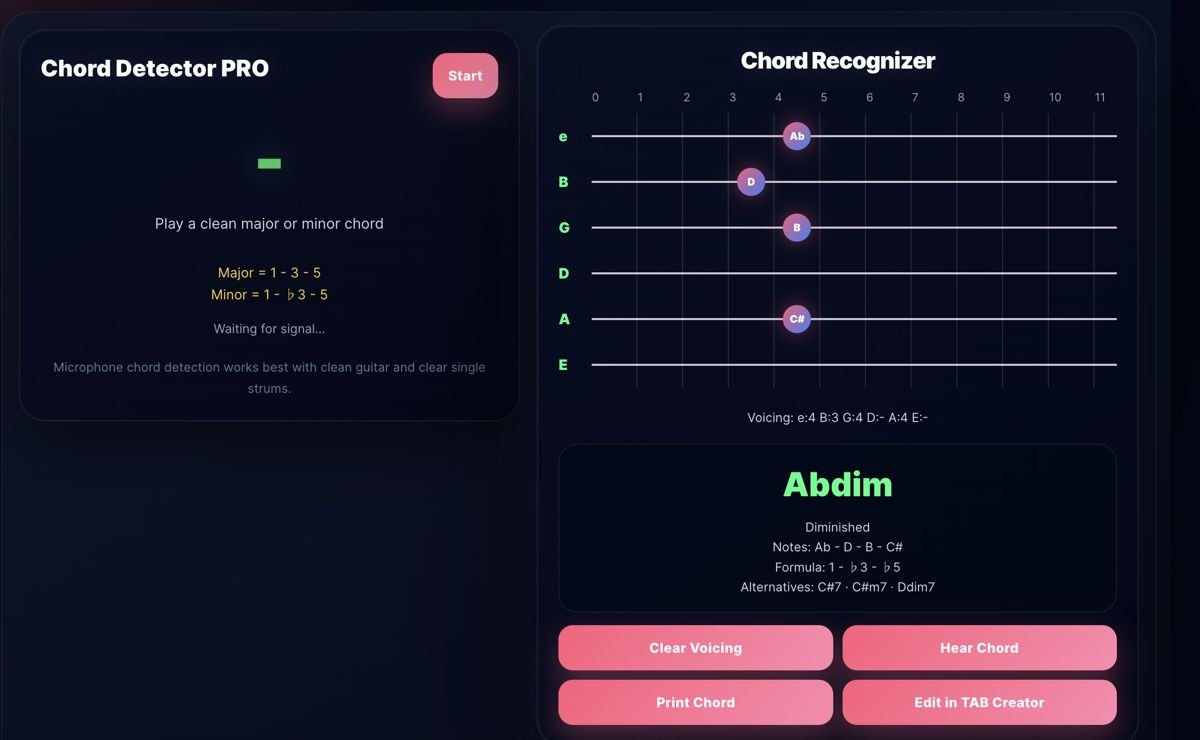
The Chord Detector PRO: real-time microphone detection maps detected notes to the fretboard and identifies the chord name, formula, and alternatives instantly.
Mode 2: Chord Progression Generator
Once you know the chord you’re working with, the Progression Generator builds a complete sequence of chords that naturally follow it — in any key, style, and length.
01
Select your key
Choose the tonal center of your progression. If you’re writing in C, select C. The generator will only suggest chords that belong to or naturally resolve within that key — no theory knowledge required.
02
Choose a style and difficulty
Select a genre style (Pop, Blues, Jazz, Rock, etc.) and a difficulty level (Easy, Medium, Advanced). Easy progressions use common diatonic chords. Advanced progressions introduce borrowed chords, secondary dominants, and modal color.
03
Generate and hear the progression
Click “Generate Progression” to get a chord sequence. Click “Hear Progression” to listen to it played back. If it doesn’t fit what you’re writing, generate again — each result is different. When you find one you like, send it directly to the TAB Creator with one click.
Chord Progression Generator — harniciuksonic.com/chord-analyzer/
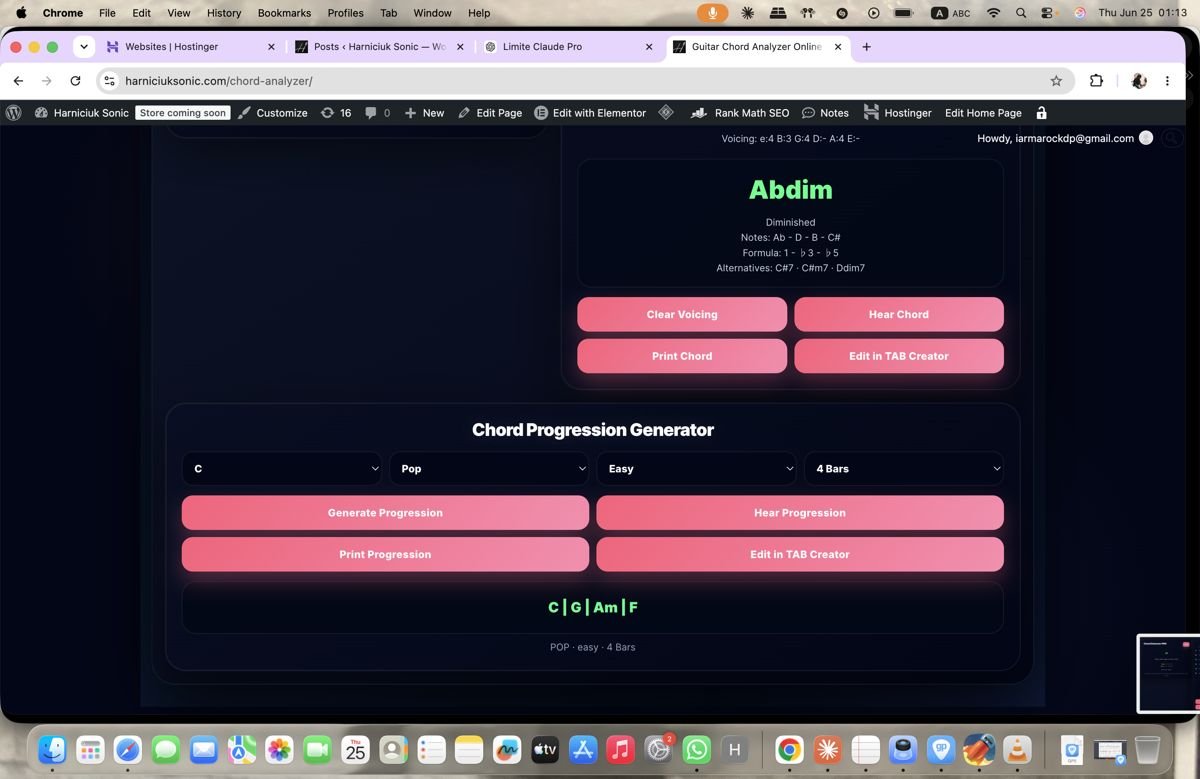
The Chord Progression Generator: key, style, difficulty, and length — then one click to generate. C | G | Am | F is one of the most-used progressions in pop music.
The most useful chord progressions in modern guitar
These five progressions appear across thousands of songs. Understanding them by name — not just shape — lets you recognize them by ear and adapt them to your own writing.
I – V – vi – IV
Pop · Rock
The Pop Progression
In C: C | G | Am | F. Used in hundreds of chart hits across four decades. Works in major keys in virtually any tempo and style. If you learn one progression, learn this one.
I – IV – V – I
Blues · Country · Rock
The Blues Foundation
In G: G | C | D | G. The harmonic backbone of blues, country, and early rock and roll. Extended to 12 bars, it becomes the 12-bar blues — the most widely played chord structure in Western popular music.
ii – V – I
Jazz · Soul · R&B
The Jazz Cadence
In C: Dm7 | G7 | Cmaj7. The fundamental harmonic movement of jazz. The ii chord creates tension, the V resolves it, and the I provides arrival. Understanding this progression unlocks jazz harmony at its core.
i – VI – III – VII
Rock · Metal · Cinematic
The Minor Loop
In A minor: Am | F | C | G. A powerful minor-key progression with a strong cyclical feel. Common in anthemic rock and cinematic music — the minor tonic gives it emotional weight while the major chords keep it moving.
I – vi – IV – V
50s · Pop · Ballad
The 50s Progression
In C: C | Am | F | G. The classic doo-wop and 50s rock and roll progression. Still used extensively in modern pop ballads and country music — the vi chord (relative minor) adds emotional depth without leaving the major key.

From analyzer to stage
Knowing chord names and progressions isn’t just theory — it’s the difference between copying songs note by note and understanding why they work, so you can adapt them, transpose them, and write your own.
When you identify a chord you heard in a song, find its formula, and build a progression around it in your own key, you’ve moved from imitating to creating.
Four practical uses for a chord analyzer
🎶
Transcribing songs by ear
Play what you hear from a recording, run it through the analyzer, and get the chord name immediately. Far faster than cross-referencing tab sites that may be wrong.
✍
Songwriting and composition
Found a chord shape you like but don’t know what it is? Analyze it, then use the Progression Generator to find what naturally comes before and after it in your key.
🎓
Learning music theory
Seeing the formula behind each chord you play builds theory knowledge through experience rather than memorization. Play a chord, read the formula, understand the interval — repeat.
🎤
Jamming and improvisation
Know what key and chords your bandmates are playing, and you know exactly which scales and notes to use. Chord identification turns listening into information.
Combine the tools
Generate a chord progression in the Chord Analyzer, then open the Scale Generator PRO and select the same key. You’ll see exactly which scale notes fit over each chord. Then open the Backing Track Generator in that same key and practice your improvisation over a full band. Three tools, one complete practice session.
Free Tools
Identify. Analyze. Create.
Chord Analyzer, Scale Generator, Backing Track Generator and more — all free, all in your browser.
Chord Analyzer
Scale Generator PRO
Backing Track Generator
Guitar Tuner
Frequently asked questions
How does the microphone chord detection work?
The Chord Detector PRO uses your device’s microphone to capture audio and runs pitch detection on the signal. It identifies individual notes in the chord, maps them to fret positions on the fretboard, and then matches the combination of intervals against its chord database to return the name, formula, and alternatives. Audio is processed locally in your browser and never recorded or stored.
What’s the difference between a chord and a chord voicing?
A chord is defined by its notes — a C major chord always contains C, E, and G. A voicing is a specific way of arranging those notes across the strings and frets. The same chord can have dozens of voicings, each with a slightly different character and register. The Chord Recognizer shows the voicing (which specific frets were played) alongside the chord name.
Can I use the chord analyzer to figure out songs by ear?
Yes — this is one of its most practical uses. Play what you hear from a recording, strum it clearly in front of your device microphone, and the analyzer returns the chord name immediately. This is faster and more reliable than looking up tabs that may be incorrectly transcribed.
What does the Chord Progression Generator actually generate?
It generates a sequence of chords (typically 4–8 bars) that work together in a given key and style. The chords are selected based on functional harmony — they follow the rules that make chord sequences feel natural and musical to the ear. You can listen to the progression, regenerate it for a different result, or send it directly to the TAB Creator to write it out.
Do I need to know music theory to use the chord analyzer?
No — but you’ll learn theory by using it. Play a chord, see its name and formula, and over time the patterns become intuitive. The analyzer works equally well for beginners who want to know what they’re playing and for experienced players who want to identify complex or unfamiliar voicings quickly.
Identify your first chord now
Free, instant, no sign-up. Play a chord, get its name, formula, and alternatives. Then build a progression around it.
Open Chord Analyzer
Scale Generator
Backing Tracks
Related reading
Once you can identify chords on the fly, Common Guitar Chord Progressions Explained shows how they combine, and Guitar Scale Generator: Map Scales Across the Fretboard connects them to the scales you solo with.
Once your progression is ready, write the guitar part in the free TAB Creator so the voicing and rhythm are easy to revisit.
When chord changes feel uneven, pair the progression work with cleaner position-shift exercises to keep unused strings quiet.