
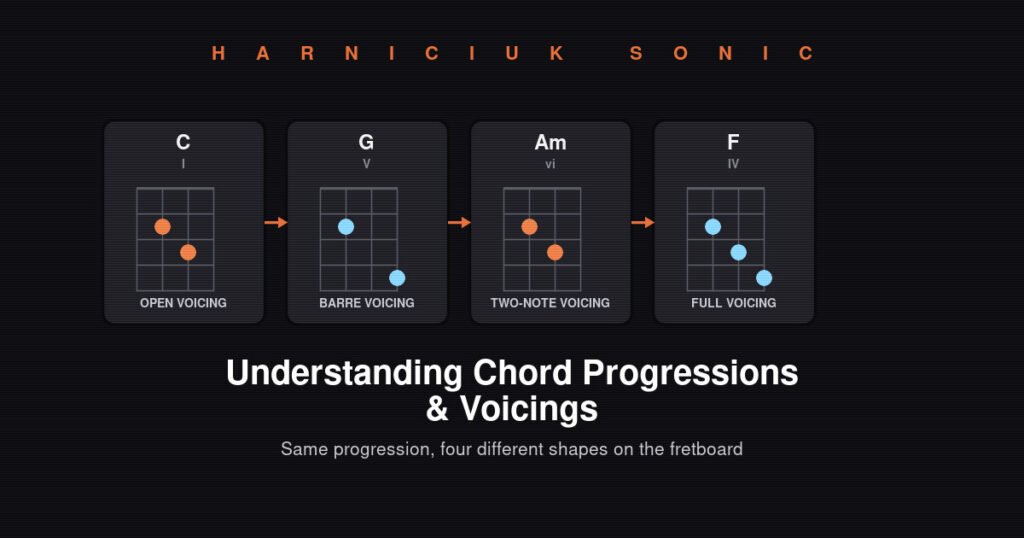
Whether you’re just starting out on your guitar journey or looking to deepen your understanding, chord progressions and voicings are fundamental concepts that can greatly enhance your playing. In this FAQ-driven explainer, we’ll dive into the essentials of chord progressions and voicings, helping you to experiment and find your own sound. These two ideas work together constantly — a progression tells you which chords to play and in what order, while a voicing decides exactly how each of those chords is shaped on the fretboard — and getting comfortable with both is what separates a guitarist who can only strum open chords from one who can shape an arrangement.
What is a chord progression?
A chord progression is a series of chords played in a sequence, one after another, usually repeating in a loop over the course of a song section. It’s the backbone of many songs, providing the harmonic support that melodies and rhythms rely on. Familiar examples include the classic 12-bar blues progression and the ubiquitous I-IV-V progression used in countless rock and pop songs, both of which show up so often that most listeners can predict the next chord in the sequence without ever having studied music theory. By understanding chord progressions, you’ll be able to recognize patterns in songs and create your own compositions. Jazz players lean heavily on the ii-V-I progression, pop and folk songs return again and again to the I-V-vi-IV pattern, and once you can hear these shapes by ear you’ll start noticing them in songs you’ve heard hundreds of times without ever consciously identifying the pattern underneath.
Why are chord progressions important?
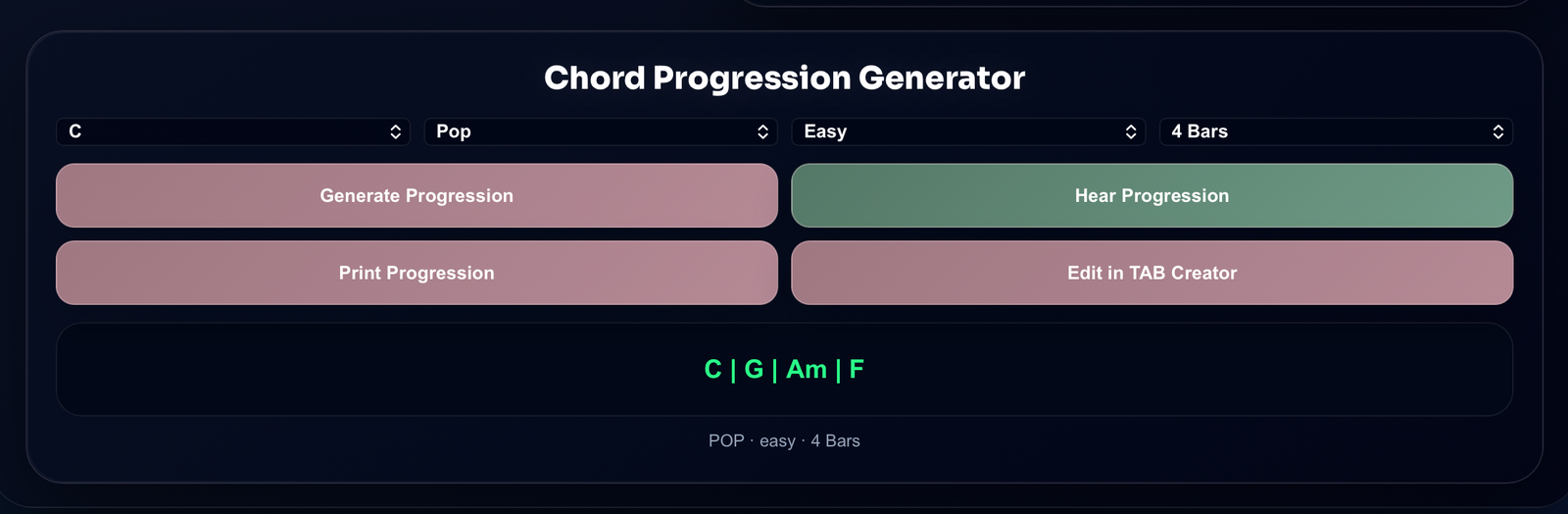
Chord progressions are crucial because they give structure to your music. They set the emotional tone, creating tension and resolution that can evoke specific feelings in the listener. Learning common chord progressions helps you to analyze songs, jam with other musicians, and write your own music with confidence. A progression that resolves neatly back to the tonic chord feels settled and complete, while one that lands on an unexpected chord can hold a listener’s attention or set up the next section of a song — that push and pull between tension and resolution is most of what makes a chord sequence feel like music rather than a random list of chords.
What are chord voicings?
Chord voicings refer to the different ways you can play a chord on the guitar. By altering the order of notes and their positions on the fretboard, you can create distinct sounds and textures. Experimenting with voicings allows you to add variety to your playing and helps to avoid redundancy, particularly if you’re playing multiple parts of a composition. A basic open C chord, a barre chord version higher up the neck, and a stripped-down two-note voicing all contain the same three notes in theory, but they sound noticeably different in context, which is exactly why arrangers reach for different voicings depending on what else is happening in the mix.
What’s the difference between a voicing and an inversion?
The two terms get used almost interchangeably, but they describe slightly different things. An inversion specifically refers to which note of the chord sits in the bass — root position has the root note lowest, first inversion puts the third in the bass, and so on. A voicing is the broader idea: it covers the inversion, but also which octave each note sits in, how spread out the notes are across the strings, and which notes get doubled or left out entirely. Every inversion is a voicing, but not every voicing changes the bass note, which is why two voicings can share the same inversion and still sound quite different.
How do I start practicing chord progressions?
Begin with simple progressions, such as C-G-Am-F, and practice transitioning smoothly between chords. Use a metronome to maintain steady timing, and gradually increase the tempo as you become more comfortable. Explore different keys and experiment with adding seventh chords or substitutions to add complexity. A metronome exposes uneven chord changes almost immediately — if the tempo has to dip every time you switch chords, that’s a sign that particular change needs isolated repetition rather than being buried inside a full run-through of the progression.
How can I explore different chord voicings?
Start by learning open chord shapes and barre chords, then try variations by omitting certain notes or adding extensions like ninths or elevenths. Use a chord analyzer to discover new voicings and practice them in different positions on the neck. This will open up new sonic possibilities and broaden your musical vocabulary.
How do chord progressions shape different parts of a song?
Verses, choruses, and bridges usually lean on chord progressions to do a lot of the emotional work. A verse might sit on a fairly stable, repetitive progression that lets the melody and lyrics carry the section, while a chorus often introduces a chord borrowed from outside the main key to give it a lift relative to everything that came before. A bridge frequently breaks the pattern entirely, moving to a new key center or a progression the song hasn’t used yet, which is part of why bridges tend to feel like a genuine departure rather than just another verse with different words. Recognizing this structure makes it much easier to write a song that feels shaped rather than just strung together.
Can you recommend some exercises for mastering chord progressions and voicings?
Certainly! Here are a few exercises to get you started:
- Practice the I-IV-V progression in different keys, focusing on smooth transitions and timing.
- Try playing a simple progression using different voicings, and listen to how the sound changes.
- Compose a short piece using a progression you’ve practiced, and play it with various voicings to see which you prefer.
- Record yourself playing different progressions and voicings to review your progress and identify areas for improvement.
- Take one familiar song and replay its progression using entirely different voicings than the recording, noticing how the mood shifts even though the underlying chords haven’t changed.
- Write a short four-chord loop, then rewrite the ending so it resolves to a different chord than expected, and compare how each version feels.
Why should I learn multiple chord voicings?
Learning multiple voicings is essential for playing with other musicians, as it allows for greater flexibility and avoids clashing. Different voicings can change the mood of a song, and having a diverse repertoire ensures you’re ready for any musical situation. In a band setting, if the keyboard player is already covering the low end of a chord, a guitarist who only knows one voicing per chord will end up doubling notes that are already covered, while a guitarist comfortable with several voicings can pick one that fills a different part of the frequency range and makes the whole arrangement sound fuller rather than cluttered.
Conclusion
Understanding chord progressions and voicings is key to becoming a more versatile and creative guitarist. By mastering these concepts, you can enhance your ability to write music, improvise, and play with others. Remember, the world of guitar is vast and full of opportunities for exploration. Keep practicing, and you’ll continually discover new ways to express yourself musically. Treat progressions and voicings as two separate skills that reinforce each other: learn the theory behind why a progression works, then spend just as much time on the physical, fretboard side of finding new ways to voice the same chords, and the two halves of the puzzle will start reinforcing each other faster than working on either one alone.
Related tools and guides
- Identify the notes and intervals with the Guitar Chord Analyzer.
- Review the building blocks in Common Guitar Chord Progressions Explained.