
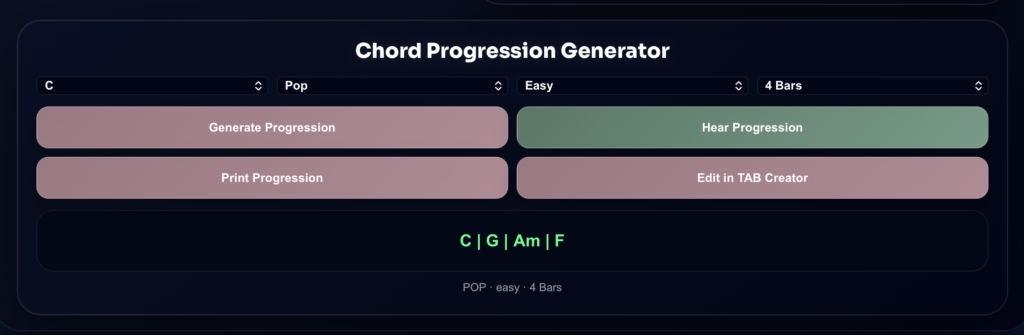
Plenty of guides list famous progressions. This one is about writing your own for a specific section of a song. For a list of common patterns, see common guitar chord progressions explained.
Start from the key’s chord family
Each major key has six chords that sound natural together. In G major:
| I | ii | iii | IV | V | vi |
|---|---|---|---|---|---|
| G | Am | Bm | C | D | Em |
Pick three or four of these and you’ll already have something that holds together.
Decide where “home” is
Choose the chord the section should feel resolved on. Usually that is G (I) for a major feel, or Em (vi) for a darker one. Start or end the loop there. A progression that never touches home feels unsettled, which can be useful for a pre-chorus.
Control tension with the V chord
D (V) creates the strongest pull back to G. Put it at the end of a phrase when you want the next line to feel like an answer. Avoid ending a verse on G every time; ending on D or C keeps the song moving forward.
Vary how long each chord lasts
Changing chords every bar is the default. Try:
- G for two bars, C for one, D for one — the first chord settles, the last two push.
- Two chords per bar at the end of a phrase to speed things up before the chorus.
Changing chord length often makes a progression sound more personal than changing the chords themselves.
Add one outside chord
Once the loop works, try swapping one chord for a borrowed one. In G, Cm (the minor iv) in place of C gives a bittersweet turn. Use it once, not every bar. The Chord Analyzer will name the chord if you find it by ear.
Test it in context
Loop the progression with a backing track and hum a melody over it. If you can’t hum anything, the progression is either too busy or doesn’t sit in one key. Simplify one chord at a time. How to identify guitar chords and create chord progressions covers working out chords by ear.
Frequently asked questions
How many chords does a progression need?
Two can be enough. Three or four is common.
Can I reuse a famous progression?
Yes. Chord progressions are shared building blocks; melody, rhythm and lyrics make the song yours.
Should verse and chorus use different progressions?
Often, but starting the same chords on a different first chord also works.
Back to the full guide: Songwriting on guitar