
An out-of-tune guitar is the fastest way to sound bad, no matter how well you play. The good news: tuning takes less than two minutes once you know what you're doing — and you can do it anywhere, for free, with nothing but a browser.
This guide covers everything: standard tuning notes, the different methods available, how to use an online tuner correctly, and the most common tuning mistakes that even experienced players make.
Standard guitar tuning: EADGBE
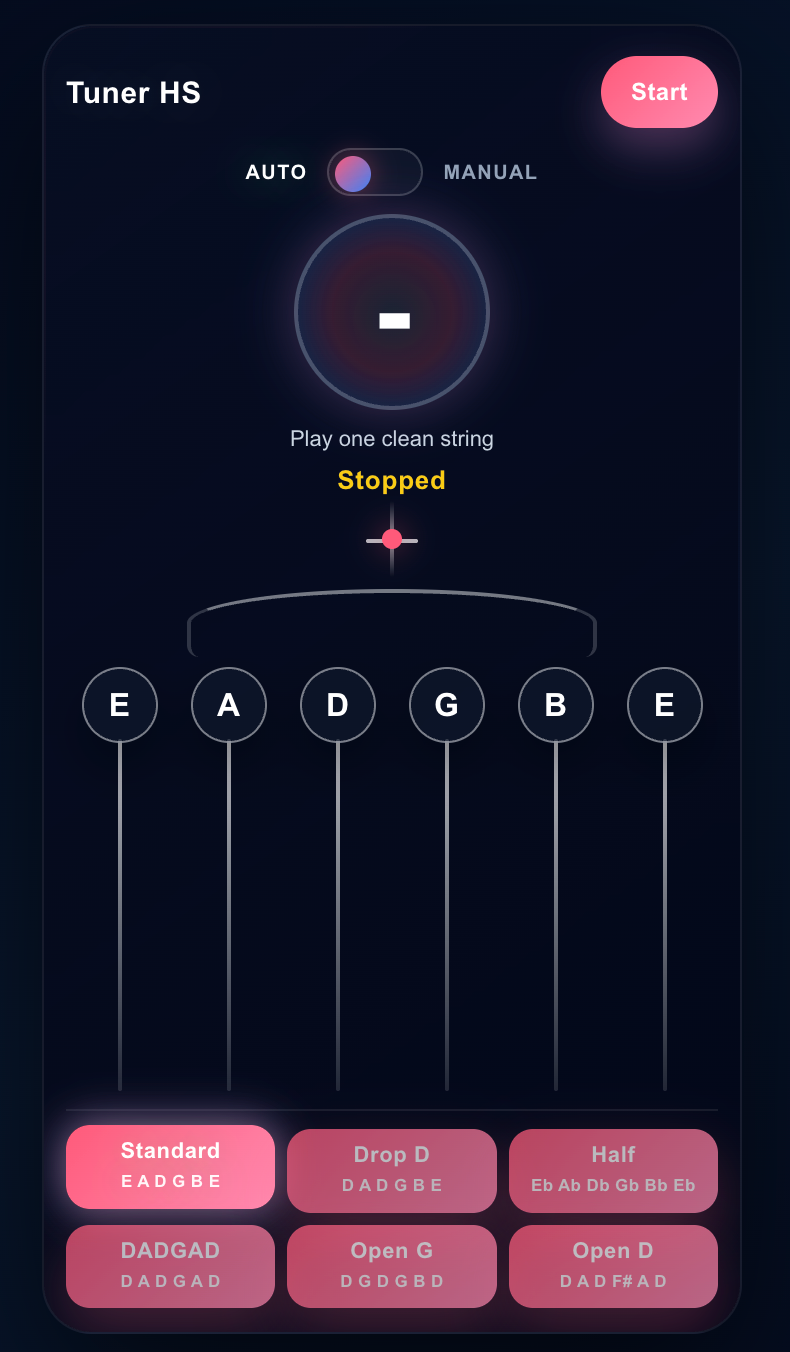
A standard 6-string guitar is tuned to EADGBE — from the thickest string (6th) to the thinnest (1st). Each string has a specific pitch, and every tuning method works by matching your string to that target pitch.
A simple mnemonic to remember the order: Eddie Ate Dynamite, Good Bye Eddie. It's not sophisticated, but it works.
Always tune up to a note, never down to it. If you overshoot, go below the target pitch and tune up again. Strings hold their tuning better when tension is applied from below — tuning down to a note leaves the string slightly loose and it will go flat faster.
The four main ways to tune a guitar
There are four methods guitarists use to tune. Each has its place depending on where you are and what you have available.
Online Tuner (browser)
Uses your device microphone to detect pitch in real time. No app, no download, no cost. Works on any device with a browser and a mic. The fastest option for most situations.
Clip-on Tuner
A small device that clips to the headstock and reads vibration rather than sound. Works in loud environments like rehearsals and gigs where a mic-based tuner would struggle.
Pedal Tuner
Connects inline with your signal chain. Silent tuning on stage — mutes your output while you tune so the audience doesn't hear it. Essential for live electric players.
Relative / Ear Tuning
Tuning strings relative to each other by ear. Useful when no tuner is available, but requires a trained ear and won't give you concert pitch (A=440Hz).

Every string tells a story. Getting them in tune is the first chapter of every session.
How to use an online guitar tuner — step by step
Using the Harniciuk Sonic online tuner takes about 90 seconds for all six strings. Here's exactly how to do it:
When you open the tuner for the first time, your browser will ask for microphone permission. Click "Allow." The tuner can't hear your guitar without it — this is required, and the audio is processed locally in your browser, never recorded or sent anywhere.
Online tuners use your device microphone, which picks up everything — TV, traffic, other instruments. Move to a quieter spot or bring your guitar close to the device mic. The cleaner the signal, the faster and more accurate the detection.
Pluck a single string cleanly without touching adjacent strings. Let it ring for a full second or two. The tuner needs enough time to detect the fundamental pitch — a muted or quickly-dampened note gives a less accurate reading.
The tuner shows the detected note and whether it's sharp (too high) or flat (too low). If the needle or indicator is to the left — flat — tighten the tuning peg. If it's to the right — sharp — loosen it. Move slowly: small adjustments change the pitch more than you expect.
When the display turns green and the needle centres, that string is in tune. Pluck it once more to confirm it stayed stable, then move on. Tune from the 6th string (Low E) to the 1st string (High E) for the most consistent result.
Tuning one string changes the tension on the neck, which slightly affects all other strings. After tuning all six, go back and check them again. New strings especially will drift significantly on the first pass. Two passes is standard practice.
Green = in tune. The goal every time.

Clip-on tuners read vibration — great for noisy environments.
Common tuning mistakes (and how to fix them)
Tuning down to a note instead of up
If your string is sharp, the instinct is to loosen the peg until it hits the right pitch. The problem: when you back off tension to reach a note, the string sits loosely and goes flat faster during play. Always go below the target and tune up.
Plucking too hard
A hard pluck briefly raises the pitch above the string's natural frequency — a phenomenon called "pitch sharp on attack." Pluck at the same strength you'd use while playing. Gentle, even strokes give the tuner a cleaner, more accurate reading.
Touching the string while it rings
Your fretting hand touching the neck or your picking hand resting on the body near the bridge affects the vibration and confuses the tuner. Keep both hands clear of the strings while the note rings for detection.
Ignoring the second pass
Guitarists in a hurry tune each string once and start playing. Within two minutes they're slightly out. Tension on one string affects the neck and all other strings — always do two full passes, especially with new strings or after a string break and replacement.
Tuning in a noisy room
Microphone-based tuners pick up all sound, not just your guitar. If you're near a TV, speaker, or other instrument, the tuner may detect that frequency instead of your string. For noisy environments, a clip-on tuner (which reads vibration through the headstock) is more reliable.
New strings go out of tune dramatically for the first few days because the material needs to stretch and settle. Tune them, play for ten minutes, tune again. Repeat this several times per session for the first two or three days. After that, they'll hold pitch properly.
Alternative tunings worth knowing
Standard EADGBE is where you start, but many styles use alternate tunings that change the character and playability of the instrument significantly.
Drop D (DADGBE)
Lower the 6th string from E to D. The most common alternate tuning in rock and metal. It gives you a deeper low end and allows one-finger power chords on the lowest three strings — ideal for heavy riffs.
Open G (DGDGBD)
The guitar rings a G chord when strummed open. Favoured in blues and slide guitar — Keith Richards plays almost exclusively in Open G, with the 6th string removed entirely.
Half Step Down (Eb Ab Db Gb Bb Eb)
Everything tuned down one semitone. Common in classic rock — Jimi Hendrix, Stevie Ray Vaughan, and Guns N' Roses used this tuning. Easier on the fingers with lighter strings, and gives the guitar a slightly darker tone.
DADGAD
A modal tuning with a drone quality often associated with Celtic folk guitar. The open strings form a Dsus4 chord — neither major nor minor — which creates an ambiguous, atmospheric sound that works well for fingerpicking and acoustic playing.
The Harniciuk Sonic tuner supports all of these tunings in one click — no manual adjustment needed.

Frequently asked questions
Can I tune a guitar online for free?
Yes. The Harniciuk Sonic guitar tuner is completely free, works in any modern browser, and requires no download or account. It uses your device's microphone to detect pitch in real time.
Is an online tuner as accurate as a clip-on tuner?
In a quiet environment, yes — a good browser-based tuner is accurate to within 1 cent, which is more than precise enough for practice and recording. In noisy environments, a clip-on tuner has the advantage because it reads vibration through the headstock rather than picking up ambient sound.
My guitar won't stay in tune. What's wrong?
The most common causes are old or new strings (new strings need stretching, old strings lose elasticity), worn nut slots (the string binds and slips), a poorly set up bridge, or cheap tuning pegs that slip under tension. If your guitar goes out of tune within a few minutes of tuning, new strings are usually the first thing to try.
Should I tune before every practice session?
Yes, always. Temperature, humidity, and the act of playing itself all cause strings to drift from pitch. Tuning takes two minutes and is non-negotiable — playing an out-of-tune guitar trains your ear to accept wrong pitch, which is a difficult habit to undo later.
What is A440 and does it matter?
A440 means the A string (5th string) is tuned to 440Hz — the international standard for concert pitch. It matters when playing with other instruments or to recorded music. If you tune to A440, your guitar will be in tune with virtually all modern recordings, other instruments, and backing tracks.
Tune your guitar now
Free, instant, no sign-up required. Works on phone, tablet, and desktop.