
Guitar Guides · Practice
A 10-Minute Daily Guitar Practice Routine That Actually Works
Structure beats duration. Ten focused minutes every day will improve your playing faster than an hour of unfocused noodling once a week.
🕑 8 min read
🎸 All levels
📅 Updated June 2026
Most guitarists don’t struggle with technique. They struggle with starting. Ten minutes feels too short to matter, so practice gets pushed to “later” — and later never comes.
Here’s the truth: frequency beats duration. When you practice the same movement repeatedly across multiple days, your brain consolidates that motor memory during sleep. A short session today and another tomorrow builds neural pathways faster than a single two-hour block at the weekend.
There’s also the consistency factor. A 10-minute routine is easy to keep. You can do it before work, after dinner, or during a lunch break. The goal isn’t to exhaust every technique in one sitting. The goal is to show up every day and make one small improvement.
The 10-minute structure
Here’s how to divide your time across four focused blocks. Each block has a specific purpose — don’t skip or swap them.
Min 1–2
Tune & Prepare
Get in tune. Relax your shoulders. Show up mentally.
Min 3–5
Timing & Rhythm
Metronome on. Chord changes or picking patterns.
Min 6–8
Focused Technique
One skill per week. Slow, accurate repetition only.
Min 9–10
Real Music
Apply technique to actual songs or improvisation.
Minutes 1–2: Tune and prepare
Never skip this. A guitar that’s even slightly out of tune trains your ear to accept wrong pitch — one of the hardest habits to unlearn later. Use an online tuner or clip-on tuner and get to standard EADGBE before you play a single note.
While tuning, do a quick physical check: relax your shoulders, loosen your fretting hand, take a breath. Tension in your body transfers directly to your playing.
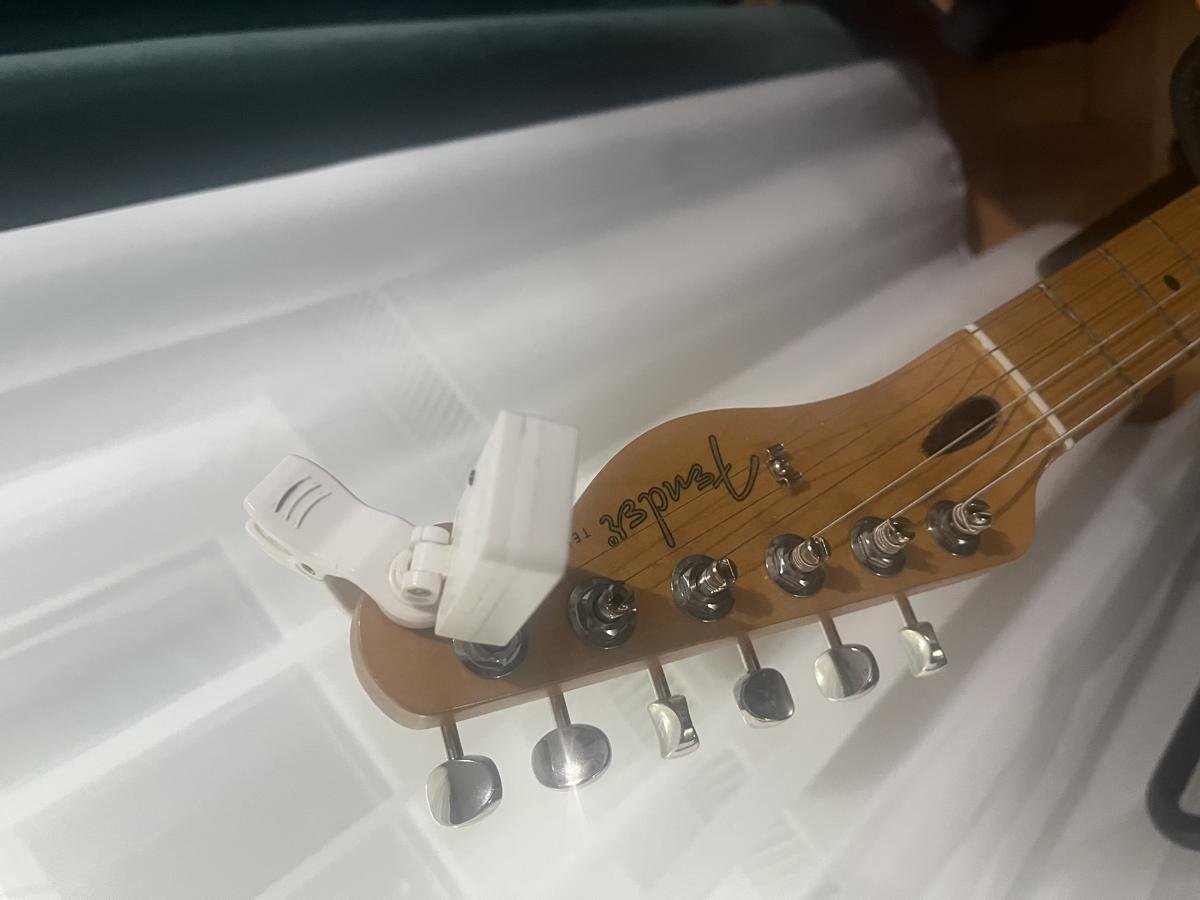
A clip-on tuner on a Fender Telecaster — the simplest way to start every session right.
Minutes 3–5: Timing and rhythm
Timing is the skill that separates amateur guitarists from players who sound professional. Set a metronome between 60–80 BPM and practice one of these:
Beginner: Open chord changes — G to C for two beats each. Focus only on the transition. Slow it down until it’s clean, then increase tempo across the week.
Intermediate: Single-note rhythm pattern on one string, alternating downstrokes and upstrokes in time. Builds pick control and rhythmic accuracy simultaneously.
Advanced: Take a riff you know at 70% speed. Exaggerate dynamics — louder loud notes, quieter quiet notes. This develops expressive control, not just mechanical accuracy.
Minutes 6–8: Focused technique
Pick one technical area and stay with it for the full week. Switching focus every session is one of the most common reasons guitarists stop improving. Good weekly focuses:
- Hammer-ons and pull-offs
- Barre chord transitions
- Alternate picking accuracy
- String bending intonation
- Left-hand finger independence
Work slowly. If your hand is tense or timing is falling apart, you’re going too fast. Speed is a result of clean repetition — not something you practice directly.
Minutes 9–10: Apply it to real music
This is the block most practice routines ignore — and it’s the most important one. Take what you just worked on and connect it to something musical. Play a chord progression. Run through a verse of a song. Improvise four bars over a backing track.
This two-minute window also recharges your motivation. Technique drills are necessary but they’re not why you picked up a guitar. Ending your session with actual music reminds your brain why the work is worth doing.
A complete weekly schedule
Here’s how to run this routine across seven days without burning out:
| Day | Technique focus | Musical application |
|---|---|---|
| Monday | Chord transitions | Song verse or chorus |
| Tuesday | Alternate picking | Riff from a song you like |
| Wednesday | Hammer-ons | Short pentatonic phrase |
| Thursday | String bending | Blues lick or solo passage |
| Friday | Barre chords | Full chord progression |
| Saturday | Free choice — hardest day revisited | Any song |
| Sunday | Rest | Passive listening & ear training |
Common mistakes that kill progress
01
Changing your routine every day
Consistency is the point. If you’re modifying the structure every session, you’re not giving any single skill enough repetitions to stick. Run the same structure for at least two weeks before adjusting.
02
Playing through mistakes
When something goes wrong, stop. Identify the exact moment the problem occurred. Isolate it, slow it down, and fix it before continuing. Playing through mistakes just reinforces the mistake.
03
Ignoring the metronome
“I’ll add the metronome later” is a guarantee of weak timing. Develop rhythm from the very first session, even at a tempo that feels almost too slow.
04
Skipping the musical application block
Technical exercises are a means to an end. Isolated technique doesn’t transfer well to actual playing. Always end with real music.
05
Measuring progress by time, not quality
The metric is: did you play something more cleanly at the end of the session than at the start? One clean improvement per session is a successful practice day.

Free Practice Tools
Everything you need in one place
Every block in this routine has a corresponding tool inside Harniciuk Sonic — free, no sign-up, works in your browser.
Guitar Tuner
Metronome
Backing Track Generator
Chord Analyzer
Frequently asked questions
Is 10 minutes really enough to improve?
Yes — if those ten minutes are structured and focused. Unfocused practice for an hour produces less improvement than ten deliberate minutes. The structure in this routine ensures every minute has a specific purpose and a measurable outcome.
What if I have more time available?
Run the routine as described, then add time to the blocks you most want to develop. If you have 20 minutes, double the technique and musical application blocks. Never extend a session just to fill time — always extend with intention.
Should I follow this routine as a beginner?
Yes. The structure is especially valuable for beginners because it removes decision fatigue. When you’re new to the instrument, deciding what to practice is a significant barrier. This routine answers that question for you.
How long until I notice improvement?
Most players notice cleaner chord transitions and more consistent timing within two weeks of daily practice. More complex improvements typically become noticeable after four to six weeks of consistent work.
Do I need any equipment beyond a guitar?
No. A guitar, a tuner, a metronome, and focused attention are everything you need. All three tools are available free at Harniciuk Sonic if you want to keep your entire practice workflow in one place.
Start today
The best practice routine is the one you actually do. Open the tuner, set the metronome, give it ten minutes. Do it again tomorrow.
Open Tuner
Open Metronome
Backing Tracks
Related reading
For more on the fundamentals covered here, see How to Use an Online Metronome for Guitar Practice and How to Tune a Guitar Online.
When the musical-application block is a complete song, use Lyrics Follow to keep the current line and next cue visible while your attention stays on timing and performance.
For cleaner daily practice, add string muting drills to the technique section and use them to reduce unwanted noise during position shifts.