Understanding Guitar TAB
Guitar tablature, or TAB, is a form of musical notation that plays a crucial role in the learning journey of many guitarists. It predates the internet by centuries in concept — lute players used a similar tablature system hundreds of years ago — and the modern six-line version simply adapted that old idea to the electric and acoustic guitar. While traditional sheet music can be daunting for beginners, TAB offers a more intuitive approach by visually representing the guitar’s fretboard. But is it as simple as it seems? Musicians who grew up entirely on TAB sometimes worry they’ve taken a shortcut that will hold them back later, while musicians trained on standard notation sometimes dismiss TAB as a lesser tool for people who never properly learned to read music. Neither extreme holds up well under scrutiny. Let’s explore some common myths surrounding guitar TAB and uncover the realities behind them.
Myth 1: TAB Is Only for Beginners
One widespread belief is that TAB is only suitable for beginners. While it’s true that TAB can simplify the learning process for newcomers, its utility extends far beyond the early stages. Experienced guitarists and even professionals use TABs to quickly learn new songs or complex solos without the need for extensive sheet music reading skills. Furthermore, TABs often include intricate details such as bends, slides, and harmonics, which are valuable for advanced players. Session guitarists working under a tight recording deadline will often ask for a TAB chart of a part specifically because it gets them playing the right notes in the right order faster than sight-reading a page of unfamiliar standard notation. Speed of communication, not skill level, is usually the real reason TAB shows up at every stage of a guitarist’s career, from a bedroom beginner to a touring professional.
Myth 2: TAB Lacks Musical Depth
Another misconception is that TAB lacks the depth of traditional sheet music. While it’s true that TAB doesn’t convey rhythmic information as effectively, many modern TABs include rhythm notations and dynamics, bridging the gap between simplicity and musical depth. For those looking to dive deeper, combining TAB with audio examples or backing tracks can enhance musical understanding and expression. Well-written TAB today typically layers standard rhythmic notation — quarter notes, eighth notes, ties — directly above or below the fret numbers, which means a lot of the “TAB has no rhythm” critique is really a complaint about poorly formatted TAB rather than a limitation of the format itself.
Common TAB Notation Symbols You Should Know
Part of why TAB can look intimidating at first is the shorthand layered on top of the plain fret numbers. Once these symbols become familiar, though, a TAB chart reads almost as quickly as plain text:
- h (hammer-on): pick one note, then sound the next higher note on the same string with a finger tap instead of picking again.
- p (pull-off): the reverse of a hammer-on — release a fretted finger to sound a lower note already ringing.
- b (bend): push or pull the string to raise its pitch, often written with the target interval, like b(full) or b(half).
- / and \ (slide up / slide down): pick one note and slide the same finger along the string to the next number without picking again.
- ~ (vibrato): a slight, repeated bend used to sustain and color a held note.
- PM (palm mute): rest the picking-hand palm lightly on the strings near the bridge for a muted, percussive tone.
- x (muted note): a percussive hit with no clear pitch, common in rhythm parts.
None of this is exotic once it clicks — it’s the same handful of symbols reused across almost every TAB chart you’ll ever read. Most guitarists pick up the full set within a week or two of deliberate exposure, simply by looking one up the first few times it appears and reusing that memory afterward.
Myth 3: Writing TAB Is Time-Consuming
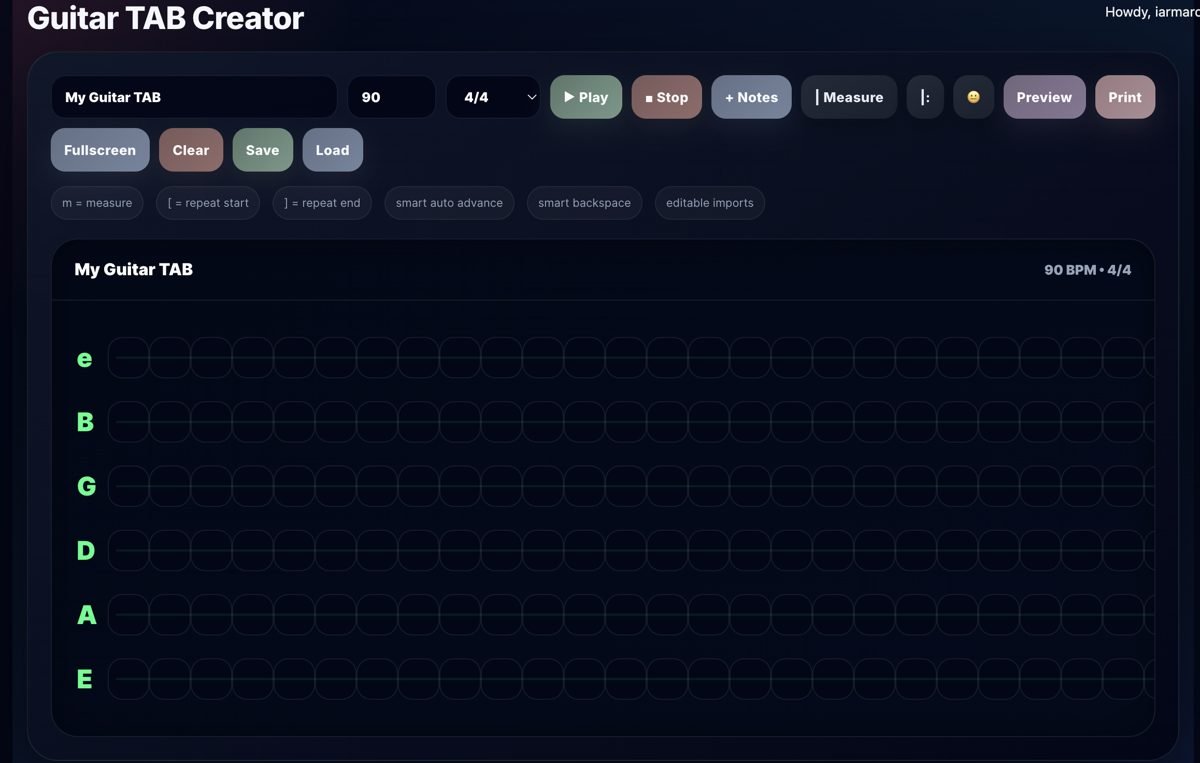
Some guitarists shy away from creating their own TABs, believing it to be a laborious task. However, with tools like the Harniciuk Sonic TAB Creator, writing TABs becomes a streamlined process. This tool allows guitarists to input notes quickly and efficiently, making it easier than ever to document original compositions or transcribe existing pieces.
Practical Example: Reading and Writing TAB
To illustrate the practical use of TAB, let’s consider the opening riff of “Smoke on the Water” by Deep Purple. The TAB would look something like this:
e|-----------------|
 B|-----------------|
 G|-----------------|
 D|-0-3-5---0-3-6-5-|
 A|-0-3-5---0-3-6-5-|
 E|-----------------|
Notice how the numbers represent the frets to be played, making it straightforward to understand the sequence of notes. A simpler example makes a good practice exercise: a plain G major triad climbing the low strings might be written as E|-----| B|-----| G|-----| D|--0--| A|--2--| E|--3--|, played one string at a time from low E upward. Once reading a short, static shape like that feels automatic, moving on to a full riff with hammer-ons and slides is a much smaller jump. Writing this riff in TAB format using the Harniciuk Sonic TAB Creator can be done in minutes, allowing you to focus more on playing and less on transcription.
When Standard Notation Still Wins
None of this makes TAB a universal replacement for standard notation, and pretending otherwise is its own kind of myth. In an ensemble or orchestral setting, standard notation is the shared language every instrument reads, so a guitarist who only knows TAB can’t hand a part to a violinist or a horn player. Standard notation is also far more precise about rhythm, dynamics, and articulation — a TAB chart tells you which fret to play, but a piece of sheet music tells you how loud, how long, and how the phrase should breathe. Guitarists preparing for formal exams, film-scoring work, or any context that involves reading alongside non-guitarists still benefit from being comfortable with standard notation, even if TAB remains the faster day-to-day tool for learning riffs and rock or pop repertoire.
Incorporating TAB into Your Workflow
Integrating TAB into your practice routine can enhance your learning experience significantly. By using tools like Harniciuk Sonic, you can create custom TABs tailored to your practice needs, whether you’re learning a new song or crafting original material. This approach aligns perfectly with the Harniciuk Sonic workflow, which emphasizes efficient practice and creative exploration. Pairing a TAB chart with a slowed-down backing track and a metronome turns a static page of numbers into an active practice loop: read a phrase, loop it at a manageable tempo, and nudge the speed up only once it’s clean, rather than fighting through a full-speed recording from the first attempt.
Conclusion: Embrace the Power of TAB
While myths about guitar TAB persist, the reality is that TAB is a versatile and powerful tool for guitarists of all levels. By dispelling these misconceptions and embracing the true potential of TAB, you can enhance your musical journey, making it richer and more rewarding. Whether you’re a beginner or a seasoned player, don’t underestimate the power of TAB in your guitar toolkit. Treat it as one tool among several — reach for it when you need to learn a part quickly, and reach for standard notation or your own ears when the situation calls for more nuance than fret numbers alone can carry. The myths around TAB tend to say more about old arguments between notation camps than about the tool itself, and guitarists who move comfortably between both formats are simply better equipped than those who insist on only one.